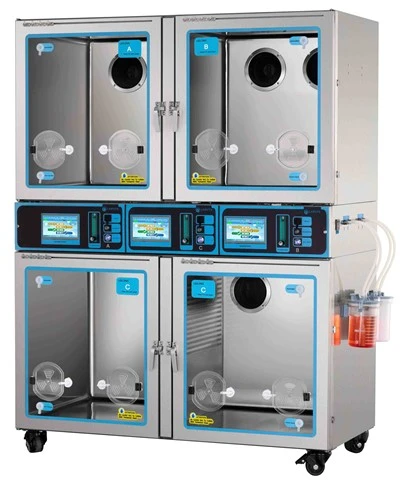


Oxygen Chamber Dog
Product Model: LEILONG VL
Input voltage: AC100V/220V~
Frequency: 50/60 Hz
Temperature control mode: One big chamber independent split cooling / PTC heating.
Description

dESCRIPTION
Why We Redesigned the Oxygen Chamber
We used to sell standard normobaric oxygen cages - the regular ones that just pump in extra oxygen at room pressure. They sold fine, but after a while, I started hearing the same complaint from four or five different clinics: "The oxygen is going in, but deep-tissue swelling isn't resolving quickly, and wound healing still takes longer than we'd like." At first I wondered if they were using it wrong. Then I read a few papers and had a long conversation with a physician who runs hyperbaric sessions for human patients. He put it bluntly - at normal pressure, there's a ceiling to how much you can raise blood oxygen partial pressure. If you want oxygen to actually reach tissue spaces and influence perfusion around bone, you need some pressure behind it.
We debated this internally for quite a while. Adding pressure means redoing the entire structural design and safety architecture, which isn't cheap. But we finally decided to go ahead with the hyperbaric version, mostly because we didn't want to keep selling something that was "good enough" but didn't really solve the problem. That decision led us to build what we now call the oxygen chamber dog - not as a marketing gimmick, but as a genuine attempt to address that clinical gap we kept hearing about.
What This Unit Actually Does in Practice
The unit we're shipping now uses a PSA oxygen generator. Oxygen concentration is adjustable from 21% up to 80%, with a listed tolerance of ±3%. In our own shop testing, we've seen fluctuations closer to ±2%, which is decent. The pressure range goes from 0 to 1.5 ATA, but from what I've observed across multiple installations, most dogs and cats actually end up staying in the 1.3 to 1.4 ATA band. Above 1.4, animals get noticeably more restless - cats especially. We tried pushing a few cats past 1.45 and they just kept circling inside. So we started recommending 1.35 as a practical ceiling for felines. It's not a parameter limitation; it's just animal tolerance, and we have to be honest about that.
The cabin uses explosion-proof glass combined with acrylic panels and a stainless steel frame. We went with acrylic mainly because it transmits light well and weighs less than glass - one person can flip the top lid open for cleaning without struggling. I think the stainless is 304 grade, though I'd have to double-check with our procurement team, but we did run a corrosion test - wiping it twice daily with chlorine-based disinfectant for a month straight, and the surface didn't discolor or pit.
There's a HEPA filter on the intake side. Honestly, it's not an expensive addition, but a lot of competitors skip it to save a few bucks. I don't think that's a good trade-off - when you're treating sick animals, you do whatever you can to reduce bacterial load. It's better to spend a little extra upfront than to deal with cross-infection later.
Safety and Usability - What We Actually Learned
On the safety side, the door has three mechanical locks, plus sensors that continuously track pressure, oxygen, and temperature inside the cabin. We set multiple trigger points - if anything drifts out of range, it vents automatically. If power cuts out, it vents too. None of this is groundbreaking in human medical devices, but it's surprisingly uncommon in veterinary gear. I remember arguing with our engineering team over the automatic pressure release valve - they said it would drive up costs too much. I told them I wouldn't sign off on the product without it. So we kept it.
The control panel comes with four or five preset treatment profiles - post-op recovery, emergency stabilization, chronic support, that kind of thing. Each profile has its own pressure, oxygen, and duration settings. You can also dial in your own values and save them by holding down the memory button for three seconds. I've done quite a few on-site installations myself, and in my experience most vet nurses pick it up after two walk-throughs. By the third try they're running it solo. One emergency hospital nurse manager told me she hates equipment with too many bells and whistles - this one she found manageable because the two most-used buttons are right up front.
Noise is something I care about personally. We tested a few competing units and some of them have a noticeable airflow whistle during pressurization. Animals tense up immediately. We went through two revisions on the muffling design, and the current version runs around 45–50 dB during ramp-up - roughly the level of an air conditioner. Depressurization is quieter. That said, if you're in a very quiet overnight ward, you can still hear it working. Complete silence just isn't realistic.
After-Sales Support - What We Actually Deliver
Warranty is one year for the full unit - free repairs and parts for non-user damage. We send our own technicians to handle installation and calibration, not third-party contractors, because outsourced guys usually can't explain the clinical reasoning - like which pressure setting works best for which condition, or when to depressurize before opening the door. We think those details matter, so we handle training ourselves.
For support response, we aim to reply to online queries within 10 minutes during business hours - that's a hard internal metric. For on-site repairs, we promise 24 to 48 hours, though honestly, in most Chinese cities we can get there within 24. Outside the country, it depends on local distributor schedules, and sometimes it stretches to three days. I don't put that in writing because we can't consistently guarantee it, and I'd rather be upfront about that limitation.
Out-of-warranty parts are charged at cost plus a small handling fee. We don't mark up consumables - hardware is our core business, not service margins. Every unit ships with a full compliance package - CE, ISO, and country-specific test reports. We prepare those for our clients because we know how time-consuming it is to chase down each country's regulatory requirements on your own. We've already done the legwork, so we just pass it along.
Who This Actually Makes Sense For
If your clinic only does a couple of minor wound closures a week, honestly, you probably don't need this. A regular oxygen cage will do fine. But if you take on a fair number of emergencies, orthopedics, or abdominal surgeries - or if you see a lot of older animals coming back for supportive care - then the economics start to look different. The **oxygen chamber dog** doesn't work miracles, but it does shorten recovery stays, reduce complications, and free up cage space faster. Those are the real cost savings.
I did a follow-up with one hospital that runs about 20 surgeries a month. After using our unit for three or four months, they told me their internal records showed Postoperative hospital stay duration had dropped by about 1.5 days on average compared to before. I'm not calling that a formal study - there was no control group, just their own historical data. But it points in the right direction. We're planning to partner with two or three larger hospitals next year to run a proper data collection, but that's still a few months out.
And here's the thing - we don't claim this is the perfect device for every clinic out there. The oxygen chamber dog has its limitations: it's not completely silent, it's overkill for low-volume practices, and international service response still has room to improve. But for the clinics that actually need what it does, it's been a solid workhorse so far. And that's really all we set out to build.
ICU host diagram

1:Three in one socket 2:Electrical Control Unit 3:Operation display 4:Inner liner Components 5:Refrigeration Components
6:External socket
ICU size chart

| MODEL | SIZE | WEIGHT | INPUT VOLTAGE | HZ | RARED POWER |
OPERATION TEMPERATURE
|
RALATIVE HUMIDITY | AIR PRESSURE | USE |
| LEILONG VL | 120CM×92.1CM×102CM | 135KG |
AC220V~
|
50/60
|
600W
|
10℃-30℃
|
≤60%RH
|
700~1060hPa
|
SMALL / MEDIUM/BIG PET |
| LEILONG VL-SS | 120CM×92.1CM×102CM | 150KG |
AC220V~
|
50/60
|
1200W |
10℃-30℃
|
≤60%RH
|
700~1060hPa
|
SMALL / MEDIUM/BIG PET |
| LEILONG LVL |
120CM×92.1CM×191CM
|
255KG |
AC220V~
|
50/60
|
1200W |
10℃-30℃
|
≤60%RH
|
700~1060hPa
|
UPPER LAYERS: SMALL / MEDIUM PET SMALL / MEDIUM/BIG PET |
| LEILONG SSVL | 120CM×92.1CM×191CM | 290KG |
AC220V~
|
50/60
|
1800W |
10℃-30℃
|
≤60%RH
|
700~1060hPa
|
UPPER LAYERS: SMALL / MEDIUM PET SMALL / MEDIUM/BIG PET |
| LEILONG FVL | 120CM×92.1CM×191CM | 310KG |
AC220V~
|
50/60
|
2200W |
10℃-30℃
|
≤60%RH
|
700~1060hPa
|
UPPER LAYERS: SMALL / MEDIUM PET SMALL / MEDIUM/BIG PET |
|
Product parameters |
|||
|
Product Model |
LEILONG VL |
Display |
7-inch super large touch screen |
|
Input voltage |
AC100V/220V~ |
Sterilization system |
External 24 hours non-stop disinfection and sterilization deodorant system |
|
Frequency |
50/60 Hz |
Maximum power consumption |
600W |
|
Temperature control mode |
One big chamber independent split cooling /PTC heating. |
Average power consumption |
0.6KW(Rooms 3-4 are used independently) |
|
Weight |
135 kg |
Power failure security |
Emergency ventilation hatch with programmed control |
|
Appearance size |
120CM×92.1CM×102CM |
Negative ion purification function |
(7.2X10⁶PCS/cm3X4)High concentration anion |
|
Air purification function |
Ultraviolet germicidal lamp; |
Dehumidification indicators |
Automatic dehumidification system, standard humidity control at 40%, actual humidity control at < 50% |
|
Conditions of use |
-10℃~30℃Environment (indoor) |
Standard spare parts |
Various hanging racks and animal sleeping baskets (optional) |
|
Set temperature |
15-45℃The temperature control accuracy±0.5℃ |
Ultraviolet sterilization |
UVC band 253nm, efficient ultraviolet sterilization system |
|
Set oxygen concentration |
21℃-65℃Control precision±1% |
The fan control |
Automatic equalizing air supply |
|
Carbon dioxide concentration, monitoring and removal |
2000-5000PPM,error±10PPM |
External humidifier |
Maximum atomization rate ≥ 0.2mL /min, fog particle (0.5-2um) noise ≤40dB(A)(optional) |
|
Alarm, warning |
Abnormal O2 concentration, temperature, sensor, CO2 concentration, and emergency hatch switch |
LED light |
There are two ways of light control: warm light is divided into ten levels and its strength can be adjusted, and cold light is used for medical examination
|

Questions We Actually Get Asked
Q: What's the real difference from a regular oxygen cage?
A: Pressure. Regular cages don't pressurize - oxygen stops at the lungs. This one runs at 1.3–1.4 ATA, so oxygen gets pushed into deep tissues and even around bones. Think soak in a tub vs. pressure shower.
Q: Can cats use it?
A: Yes, but keep pressure under 1.35 ATA and ramp up slow. About one in ten cats stays nervous the whole time - for those, we don't push it. Always do a 10-minute trial run first.
Q: How many sessions for a dog with pancreatitis?
A: Depends. Most show improvement around session 3 or 4, but some respond after one, others take five. I can't give you an exact number - severity and complications vary too much.
Q: Is daily maintenance a hassle?
A: Two things - wipe the cabin surface and check the HEPA filter. No dead corners, disinfectant works fine. Filter every 3–6 months. That's it. Parts are tested to last 2–3 years under normal use.
Q: What about service in rural areas?
A: Most Chinese cities - 24 hours. Remote counties - more like 1–2 days. For those, we provide video guides and remote troubleshooting first. Hardware failure? Then we send someone. Outside China - distributor dependent, I can't guarantee timing.
Q: Where do you fall short against imported brands?
A: Our UI isn't as polished - functional but not pretty. Less published clinical data too - we're still collecting. Price is lower, performance is comparable, but branding and interface finesse? We're catching up.
Q: What cases should NOT use this?
A: Pneumothorax, barotrauma risk, severe airway obstruction. Also extremely anxious animals - forcing them in makes it worse. All in the manual and covered during training.
Q: Expensive to maintain after warranty?
A: Parts at cost plus small labor fee. We don't mark up service - hardware is our business. First 2–3 years you won't need major replacements anyway. Seals and small parts are cheap.
Q: Have you treated animals with it yourselves?
A: Our office Corgi - 12 years old, bad hind legs. We put her in the oxygen chamber dog every 2–3 weeks, 40 minutes at 1.3 ATA. Not a cure, but she moves lighter for a couple of days after. That's where my real confidence comes from.
Q: What do you wish you could improve?
A: Noise - 45–50 dB is okay but still audible in a quiet ward. I want under 40 dB in the next version. Also overseas service response. Those are the two real weak spots on the oxygen chamber dog right now.
Hot Tags: oxygen chamber dog, China oxygen chamber dog manufacturers, suppliers, factory
Send Inquiry
You Might Also Like