



Pet Care Unit
Animals that suffer from heat stroke often have undergone intense exercise or have just been exposed to high temperatures and humidity. The body temperature is not necessarily high, but can be normal or hypothermic. Other symptoms may include severe depression, weakness, panting, tachycardia,...
Description

What I've Learned About Post-Op Recovery (And Why the Pet Care Unit Actually Helps)
You know that feeling when a patient's under anesthesia and you're already worried about the awakening phase? That's where things go wrong-not during surgery.
The Pet Care Unit I've been using handles the critical stuff automatically so I don't have to stand there monitoring all night.
The Oxygen Piece: Numbers You Can Work With
Here's what matters clinically: When I hook up a standard 10L/min oxygen source, this unit hits 45% O2 in about 16 minutes. Want 55% Fifteen minutes? Those aren't marketing numbers-I've verified them with our clinic's oxygen generator.
The automatic cutoff is the part I actually trust. Once it hits your set concentration, oxygen stops. No manual monitoring, no worrying about oxygen toxicity while you're in another exam room. Drop below set value? It restarts. Basically babysits itself until the patient's ready to come off.
Humidity: The Overlooked Variable
We don't talk about this enough in vet school. Sick patients generally need dry, not humid. Pulmonary edema? High humidity worsens it. Wound healing? Moisture invites bacteria.
The Pet Care Unit pulls humidity out via the AC dehumidification-doesn't need a separate system. For nebulization treatments, you can override and add humidity. But for post-op and most respiratory cases, keeping it on the drier side has made a noticeable difference in my patients' recovery times.
Safety Stuff That Actually Matters
The chamber material is scratch-resistant. If you've ever had a panicking post-op cat claw through a soft carrier mid-recovery, you'll appreciate this. No injuries, no escape attempts.
Door seals are soft enough that even if a groggy patient flops against the edge, no pinching. And the air circulation runs separate from room air-reduces that "sick ward" smell and cuts cross-contamination risk.
The Clinical Settings I Actually Use
After some trial and error, here's what works:
* Pulmonary edema, heart disease, heat stroke: High O2, low humidity, low temp
* Respiratory infections, nebulization: High O2, high humidity
* Post-op wounds, healing tissue: High O2, low humidity
* Neonates: High O2, high temp, high humidity
* Post-op recovery, hypothermia: High O2, high temp, low humidity
That Teddy Dog Case
Three-year-old neuter, routine surgery. Wakes up with weak respirations and temp at 37.2°C. Placed in the Pet Care Unit: set 50% O2, 30°C.
* 15 minutes: Oxygen concentration hits 50%
* 60 minutes: Spontaneous breathing normal. Temperature 38.5°C. Out of danger.
Could he have recovered without it? Maybe. But I've seen enough borderlines tip the wrong way to know this unit made the difference.
Fifth generation, eight years of vet feedback. Does what we'd do manually if we could stand bedside 24/7.
TECHNICAL SPECIFICATIONS
Input voltage: AC220V~
Frequency: 50/60Hz
Rated power:500W
Weight:80KG
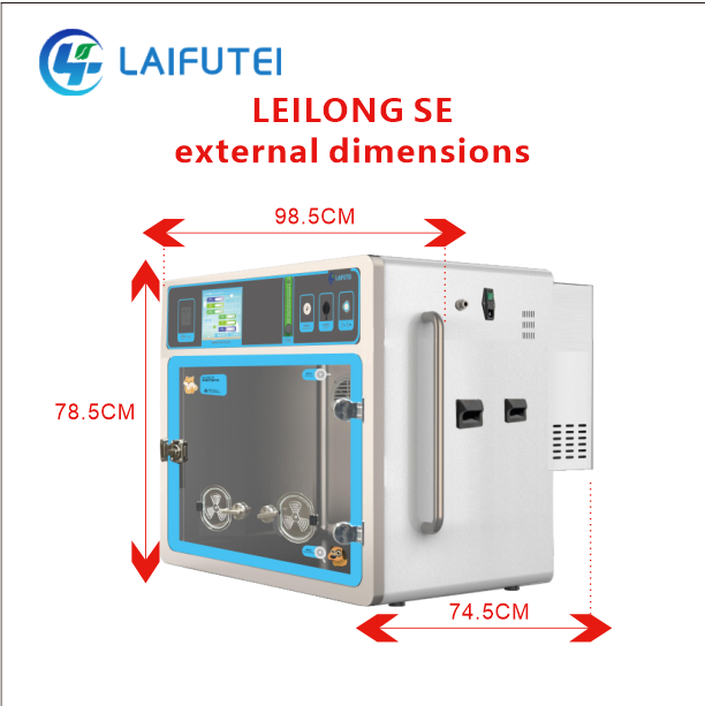
Dimension of the appearance:98.5CM*78.5CM*74.5CM
REQUIREMENTS OF WORKING ENVIRONMENT
Operation temperature:10℃-40℃
Relative humidity:≤60%RH
Atmospheric pressure:700hPa~1060hPa
Application Scenarios
It is mainly used for sick, critical, weak, or post-operative pets for temperature recovery, infusion, oxygen therapy, nebulization, emergency rescue, and hospitalization. It also supports sterile, constant-temperature nursing for young pets.
Schematic Diagram Of The Product
1:Stainless Steel Liner 2:operation panel 3:Tempered glass door 4:Visitation Window 5:Electrical Control Unit 6:Refrigeration Components 7:Infusion Support
PRODUCT SIZE


|
Product parameters |
|||
|
Product Model |
LEILONG SE |
Display Touch screen |
10-inch super large touch screen |
|
Input voltage |
AC100V/220V~ |
Sterilization system |
External 24 hours non-stop disinfection and sterilization deodorant system |
|
Frequency |
50/60 Hz |
Maximum power consumption |
1.3KW |
|
Temperature control mode |
one chamber independent split cooling /PTC heating. |
Average power consumption |
0.5KW(Rooms 3-4 are used independently) |
|
Weight |
80 kg |
Power failure security |
Emergency ventilation hatch with programmed control |
|
Appearance size |
98.5CM×78.5CM×74.5CM |
Negative ion purification function |
(7.2X10⁶PCS/cm3X4)High concentration anion |
|
Air purification function |
Ultraviolet germicidal lamp; High concentration anion air purification |
Dehumidification indicators |
Automatic dehumidification system, standard humidity control at 40%, actual humidity control at < 50% |
|
Conditions of use |
-10℃~40℃Environment (indoor) |
Standard spare parts |
Various hanging racks and animal sleeping baskets (optional) |
|
Set temperature |
15-38℃The temperature control accuracy±0.5℃ |
Ultraviolet sterilization |
UVC band 253nm, efficient ultraviolet sterilization system |
|
Set oxygen concentration |
21℃-60℃Control precision±1% |
The fan control |
Automatic equalizing air supply |
|
Carbon dioxide concentration, monitoring and removal |
300-5000PPM,error±10PPM Built-in medical CO2 high-efficiency purifying agent and automatic CO2 removal device |
External humidifier |
Maximum atomization rate ≥ 0.2mL /min, fog particle (0.5-2um) noise ≤40dB(A)(optional) |
|
Alarm, warning |
Abnormal O2 concentration, temperature, sensor, CO2 concentration, and emergency hatch switch |
LED light |
There are two ways of light control: warm light is divided into ten levels and its strength can be adjusted, and cold light is used for medical examination |

MAINTENANCE AND INSPECTION
Inspection items
Regularly inspect the intake filter, dust blockage can reduce oxygen output and equipment lifespan.
Regularly inspect the surrounding environment of the equipment to prevent excessive dust from entering the equipment, blocking the intake filter, and causing equipment damage;
fuse replacement
The fuse holder of the device is located below the power switch. You can directly remove the faulty fuse and replace it with the new fuses, then press in the power cover.

motor pump replacement
After running the equipment for 800-2000 hours, the motor pump may fail. You can contact the agent or replace it yourself.
First, remove the four screws on the left board and remove the left board. Then remove the faulty motor and unplug the connector (be careful not to unplug the wire, it is best to use sharp-nosed pliers at the joint) and replace the good motor.


FAQ
Q: How many different types of products does your company produce?
Q: When can I get the price?
Q: What is your MOQ?
Q: What are your payment terms?
Q: How long is your delivery time?
Hot Tags: pet care unit, China pet care unit manufacturers, suppliers, factory, pet icu feeding tubes, icu for pet heart problems pets, veterinary icu bronchodilators for pets, pet icu dressings, veterinary icu heart medications for pets, pet icu oral surgery
Send Inquiry
You Might Also Like


